Your Hosting Provider Is Shaping Your Business Reputation — Are You Paying Attention?

Photo: Ana Las Heras, CC BY-SA 4.0, via Wikimedia Commons
Most British business owners can recall, with reasonable accuracy, what they pay for their accountant, their insurance, and their office supplies. Ask them about their hosting provider, and the response is frequently a pause, followed by a vague figure and the name of whichever company they signed up with when the website was first built. It is, for many, the most passive expenditure in the entire business budget.
That passivity carries a cost that rarely appears on any invoice but manifests in ways that are difficult to ignore once you know where to look: slow-loading pages, intermittent outages, declining positions in search results, and customers who quietly give up and go elsewhere.
What Hosting Actually Does — and Why It Matters
A web hosting provider is, at its most fundamental level, the company responsible for keeping your website accessible to the world. When someone types your address into a browser, their request travels to a server — a physical or virtual machine — where your website's files are stored. The speed of that journey, the reliability of the server, and the quality of the infrastructure surrounding it determine whether the visitor has a smooth experience or an infuriating one.
For British businesses serving a predominantly UK audience, the location of that server is not a trivial consideration. A server physically located in the United Kingdom will, all else being equal, respond to a request from a British visitor more quickly than one hosted in the United States or elsewhere. Milliseconds matter — not merely because of user experience, but because search engines, including Google, factor page loading speed into their ranking calculations. A slow site is a penalised site.
 Photo: United Kingdom, via static.vecteezy.com
The Uptime Illusion
Hosting providers compete aggressively on uptime guarantees. "99.9% uptime" appears in the marketing materials of almost every provider in the market. What this figure actually means is worth examining.
99.9% uptime permits approximately 8.7 hours of downtime per year. For a business trading seven days a week, those hours represent real periods during which customers attempting to visit the website — or, worse, attempting to complete a purchase — encounter an error message and leave. The damage is not merely the immediate lost transaction; it is the impression formed about the business's reliability.
More concerning is the gap between guaranteed uptime and actual uptime. Guarantees are frequently expressed in terms of credit entitlement — meaning that if your site goes down, you may receive a partial refund of your hosting fee. The commercial damage caused by the outage, however, is not compensated.
Independent uptime monitoring — using services that test your website's availability at regular intervals and alert you when it goes offline — provides a far more accurate picture of your hosting provider's actual performance than any contractual guarantee.
Server Location and British Search Performance
The relationship between server location and search engine performance deserves particular attention for UK-focused businesses. Google's algorithms assess a range of signals to determine whether a website is relevant to a specific geographic audience. Server location is one such signal, though it interacts with others including the domain extension (a .co.uk domain carries strong UK geographic signals) and the use of geotargeting settings within Google Search Console.
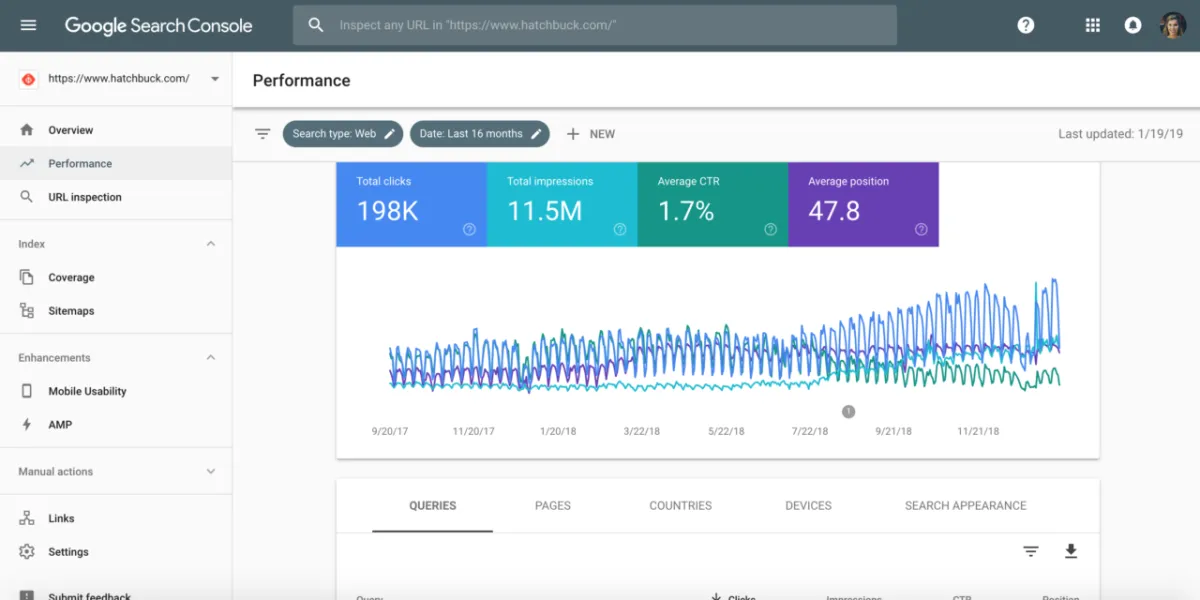 Photo: Google Search Console, via www.benchmarkone.com
For businesses that have not verified their website in Search Console, or that are hosted on servers located outside the UK without compensating technical measures such as a content delivery network, the result may be reduced visibility in local and regional search results — precisely the searches most likely to drive customers through the door.
A content delivery network, or CDN, can mitigate the distance penalty by caching website content across multiple server locations globally. However, for smaller British businesses without the technical resource to configure and maintain such infrastructure, choosing a hosting provider with UK-based servers in the first instance is the simpler and more reliable solution.
Support Quality: The Factor Nobody Considers Until It's Too Late
Hosting support tends to be evaluated only at the moment of crisis — which is precisely the worst time to discover that your provider's response times are measured in days rather than hours, or that their support team operates exclusively during hours that do not align with British business needs.
The cheapest hosting options available to British businesses are frequently provided by large international platforms with support operations based overseas. For routine queries, the quality difference may be imperceptible. For urgent issues — a site that has gone offline during a promotional campaign, an SSL certificate that has failed to renew automatically, a database error that is preventing customers from completing orders — the difference between a provider that answers the phone and one that requires a support ticket to be raised and queued can be measured in revenue.
When evaluating hosting providers, it is worth specifically investigating the support model: whether telephone support is available, what the stated response times are for different categories of issue, and whether those response times are backed by any meaningful commitment.
Shared Hosting and Its Neighbours
The majority of British SME websites are hosted on shared servers — meaning that the physical or virtual machine on which your website resides also hosts dozens or hundreds of other websites. This is not inherently problematic; shared hosting is a cost-effective solution for many businesses at many stages of growth.
The difficulty arises when other websites sharing your server experience high traffic volumes, run poorly optimised code, or — in the most serious cases — are compromised by malicious actors. In a shared hosting environment, the performance and security of your website can be influenced by the behaviour of neighbours you have never met and cannot control.
For businesses whose websites are a primary revenue channel — e-commerce operations, service businesses that generate a significant proportion of their leads online — the additional investment in a virtual private server or managed hosting arrangement provides meaningful protection against these risks.
What to Look for When Reviewing Your Hosting Arrangement
A structured review of your current hosting provider does not require technical expertise. The following questions provide a reasonable starting framework.
Where are the servers located? If your primary audience is in the United Kingdom, UK-based servers are preferable. Your provider should be able to answer this question directly.
What is the actual uptime record? Ask your provider for historical uptime data, or use an independent monitoring service to gather your own. Compare this against the contractual guarantee.
How is support accessed, and how quickly does it respond? Test this before you need it. Raise a non-urgent query and note both the response time and the quality of the answer.
What backup arrangements are in place? Automatic, regular backups stored separately from the primary server are essential. Understand how frequently backups are taken and how quickly a restore can be performed.
Does the price reflect the service? The cheapest hosting is rarely the most cost-effective when the full impact on site performance, search visibility, and support availability is accounted for.
The Quiet Cost of Complacency
Hosting is not the most glamorous aspect of running a business online, and it rarely receives the attention it deserves. But the infrastructure on which your website runs is not a passive background expense — it is an active determinant of how customers experience your business every time they visit.
For British businesses that have never revisited their hosting arrangement since the website was first launched, the return on a few hours of evaluation can be considerable. The right hosting environment will not transform a poor website into a successful one, but the wrong one will quietly undermine even the most well-crafted digital presence.